Friday, December 11, 2015

December Fun - Area, Volume, & Surface Area with Gingerbread Houses

In math class, we have started a tradition of building and decorating Gingerbread Houses as part of our Geometry unit. Students have been challenged to find the perimeter, surface area, and volume of their Gingerbread Houses.  We will provide graham crackers and frosting due to local donations, and we ask the students to bring their favorite candies to decorate their houses.

The students have been working on building gingerbread houses as a culmination of the area, perimeter, volume, and surface area unit.

In a two week time frame, the students learned the definitions and formulas for area, perimeter, volume, and surface area as well as practicing each and showing understanding of each standard.

Below is the slideshow of what it is, how to find it, examples, and real life applications. 
Perimeter, Area, Volume, & Surface Area

Teachers, faculty & staff voted on the Gingerbread Houses:


The students voted for their favorites by hour:


Here are the students and their Gingerbread House creations 


Friday, November 6, 2015

Decimals - Round & Powerful for our Answers

This week in class (hours 2, 4-6), we learned to add and subtract decimals.  To begin with, students were asked what is IMPORTANT to know when adding and subtracting decimals?  With their answers, we created rules...


Rules for Addition & Subtraction of Decimals
1.) Line up your decimals.
2.) Add zeros after the decimal point so that all of the numbers have the same number of places after the decimal.
3.) Add/Subtract as you would with whole numbers. 
4.) Just move the decimal point straight down in your answer. 


Throughout the week, the student had plenty of opportunities to practice addition and subtraction. Below are the assessments the students did this week:


This week in class (hours 3 & 7), we learned to multiply and divide decimals.  To begin with, students were asked what is IMPORTANT to know when multiplying and dividing decimals?  With their answers, we created rules...


Rules for Multiplication of Decimals
1.) Line up your numbers with the last digits under each other. 
2.) Multiply as you would with whole numbers. 
3.) Add the decimal places in each of the numbers being multiplied. 
4.) Move the decimal point to the LEFT the TOTAL number of places in the numbers being multiplied. 


Rules for Division of Decimals
1.) Move the decimal point in the divisor (the number on the outside of the division house) to the RIGHT to make it a whole number. 
2.) Move the decimal point in the dividend (the number on the inside of the division house) to the right the number of places you moved the decimal on the outside. 
3.) Divide as you would with whole numbers. 
4.) Move the decimal point in the Quotient (your answer) directly above the decimal point you moved in the dividend. 


Throughout the week, the student had of opportunities to practice multiplication and division of decimals. Below are the assessments the students did this week:


All classes also took an assessment on Mastery Connect. The students were assessed on addition and subtraction of decimals. 
CCSS.MATH.CONTENT.6.NS.B.3 Fluently add, subtract, multiply, and divide multi-digit decimals using the standard algorithm for each operation.
Through Mastery Connect, teachers can assess core standards, monitor student performance, and report student mastery to parents and administrators.

Tuesday, October 27, 2015

"Decimals Have a Point"

CCSS.MATH.CONTENT.6.NS.B.3
Fluently add, subtract, multiply, and divide multi-digit decimals using the standard algorithm for each operation.

Today, we are taking a Pre-Assessment for our Decimals Unit, which will be used as an indicator for how the unit flows for each class. The Pre-Assessment is for checking understanding of addition, subtraction, multiplication, and division of decimals through computation, word problems, and real life applications.

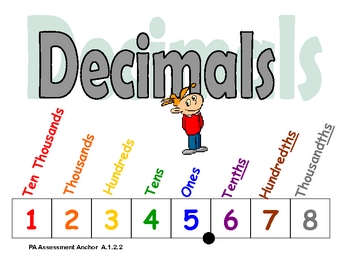
Definition of Decimal


The word "Decimal" really means "based on 10" (From Latin decimaa tenth part).
We sometimes say "decimal" when we mean anything to do with our numbering system, but a "Decimal Number" usually means there is a Decimal Point.

Large and Small

Our Decimal System lets us write numbers as large or as small as we want, using the decimal point. Digits can be placed to the left or right of a decimal point, to show values greater than one or less than one.
The decimal point is the most important part of a Decimal Number. Without it we are lost, and don't know what each position means.
23. 680
On the left of the decimal point is a whole number (such as 23). As we move further to the left, every place gets 10 times bigger!
The first digit on the right means tenths (1/10). As we move further to the right, every place gets 10 times smaller (one tenth as big)! 


Friday, October 16, 2015

A Little Late but Not Forgotten

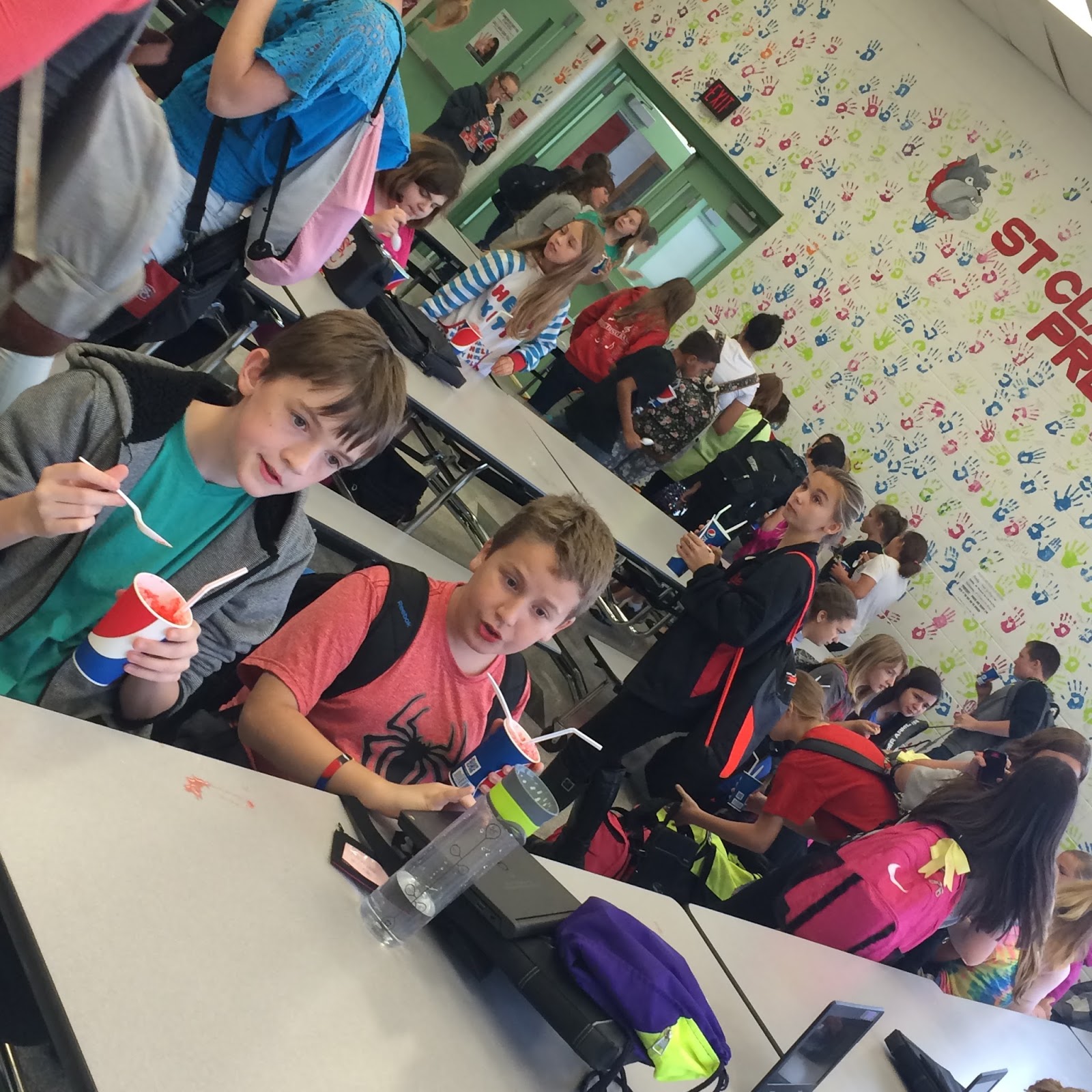
First Quarter ST Math incentive --- Any student who increased his/her syllabus progress by 15 or more percent received the incentive to go to the cafeteria to receive a sno-cone and enjoy free time either in the cafeteria or on the turf field. 

A big thank you to Dana's Shaved Ice for donating the syrup for sno-cones, the Edgar Murray building and St. Francis Borgia grade school for allowing us to use their sno-cone machines!

Below are pictures of the 6th graders from the event...


Tuesday, October 6, 2015

Figure Me Out

We all have numbers that mean something to us. Numbers that are very important in our lives: birth dates, lucky numbers, siblings, favorite sports athletes, etc.  When you're 12, you tend to like the number 12!  If you were born on July 29, you usually smile a little or get happy when you see the number 29.”

For this project, the student will demonstrate his/her understanding of the order of operations by creating a poster or Google presentation that incorporates numbers (and computation) into a page about their own lives.

The student will use the strategies and rules they've learned about Order of Operations to create problems using the numbers that are significant to their life.

The students need to include the following:
  1. You need to have at least 5 (regular math) or 7 (AC math) problems.
    1. Using numbers that are significant to your life. (ie. birthday, age, shoe size,  # of people in your family, # of states you’ve visited, etc.)
  2. Each problem must have at least 3 steps
  3. You must have at least 1(regular) or 2(AC) problems with exponents
  4. You must have at least 1(regular) or 2(AC) problems with parentheses
  5. You need to solve each equation
  6. You may include pictures (as long as they are school appropriate)

GOAL : The SIGNIFICANT NUMBER is the answer to the order of operations question.
ie. Shoe Size is 9, so the answer to the problem should be 9.

For Exceeds - You need to include negatives, decimals, &/or fractions in at least TWO of your problems.

Students have begun working on their Figure Me Out Projects and are very interested in the project as it it completely about them. The students love to share about themselves, and this project is the perfect way for them to tell their classmates about themselves. 


Monday, September 28, 2015

Order of Operations - PEMDAS


This week, both Regular Math and AC Math are solving Order of Operations problems, referred to as TORNADO problems in class... Tornadoes are rated based on wind and damage and our order of operations problems will progressively get harder and become more intense. We start out with very basic problems; basic operations: add, subtract, multiply, & divide (F1, F2, & F3). Then the problems will increase in difficulty...adding in parentheses & exponents (F4 & F5).


Throughout the unit, the students learned several strategies to solve the problems as well as learned a song to remember the steps for solving. .

Click here to watch the Youtube video for the rap song -->

Order of Operations Rap Song


Wednesday, August 19, 2015

Back to School 2015-2016

School is underway! The classroom is set up and ready to go, and now the students have arrived! Let the school year begin!

The BRIGHT, inviting ...AND fun math classroom!


Cannot wait for the fun to begin with these 6th graders! Happy FIRST DAY!